
Table of Contents
Finding my why
In February 2021, we hosted a “Teacher Health and Wellness” virtual retreat. It seemed fitting at the time. Instead of pumping ourselves full of more PD, could we gather and pause? Take a break and learn how to recenter ourselves in the midst of a global pandemic?
I attended a session by my friend, Jen Rafferty, and can honestly say it changed my life. (If you’ve been reading my work for a while, you already know this because I talk about it quite frequently!!). In this session, Jen shared the very powerful concept that not only could we drill down our why to a seven word statement, but we could use that why to fuel our choices for how we approached our jobs and the spaces we occupied.
Even though I was moderating this session, I was actively involved with the other participants–scribbling ideas down and culling statements until I got to a clear statement of my personal and professional why:
I connect people through creativity and community
It was as if my entire calling and greatest joys in life were boiled down to a single statement. My work as a high school teacher? I connect people through creativity and community. My work at F-flat Books? I connect people through creativity and community. The reason I started a book club, or serve as worship director, or write songs with my band, or push my friends to do scary creative things that they don’t think they can do? I connect people through creativity and community. It’s even on the homepage of my personal website!
Turning that why into action
Our work didn’t stop with finding our why. Our next work might have been the most important part of the entire session. We all wrote down how we wanted to feel in our jobs, in our classrooms. Then, we wrote down the ways that we could actively work toward making that feeling a reality. We tapped into our agency as humans.
You see, there is so much in education that is beyond our control. I can’t control my building’s schedule, my coworkers, the larger educational system of the United States, testing mandates, my pay scale, and the list goes on and on. Even as a college professor with greater flexibility, I recognize the many ways in which I am part of a larger system that puts constraints on what I can and can’t do.
But guess what? There is so much we can control. This is the part of Jen’s talk that felt transformative for me. If I want to feel “calm” and “grounded” in my classroom space, what could I do to make that happen? (Install twinkle lights! Diffuse some lovely scents! Fill my classroom with decor and spaces that reflect my intentions.) If I want to feel focused and present with my students, what can I do to make that happen? (Stop checking email first thing in the morning and spiraling before I even get to school, leave my phone in my office, etc.).
When I was in the throes of hybrid teaching, this lesson felt revolutionary to me. Suddenly, I could see all of the spaces where I did have control (read: my emotional inner-life) and where I could take action to cultivate the career I so longed for. But I didn’t stop with me, I wanted to take these ideas to my students.
Empowering kids to take control
That fall, in 2021, I started a ritual that I would continue every year since then. I handed out blank notecards to my string orchestra students and asked them this question:
When you walk into this room, how do you want to feel?
Then, I had them respond to the following:
What actions can you take to manifest that feeling?
Their answers surprised me with their depth and breadth. I was so moved by reading their answers of wanting to feel calm, confident, joyful, content, and so much more, that I decided to pin their words up in the back of our orchestra room for everyone to see.
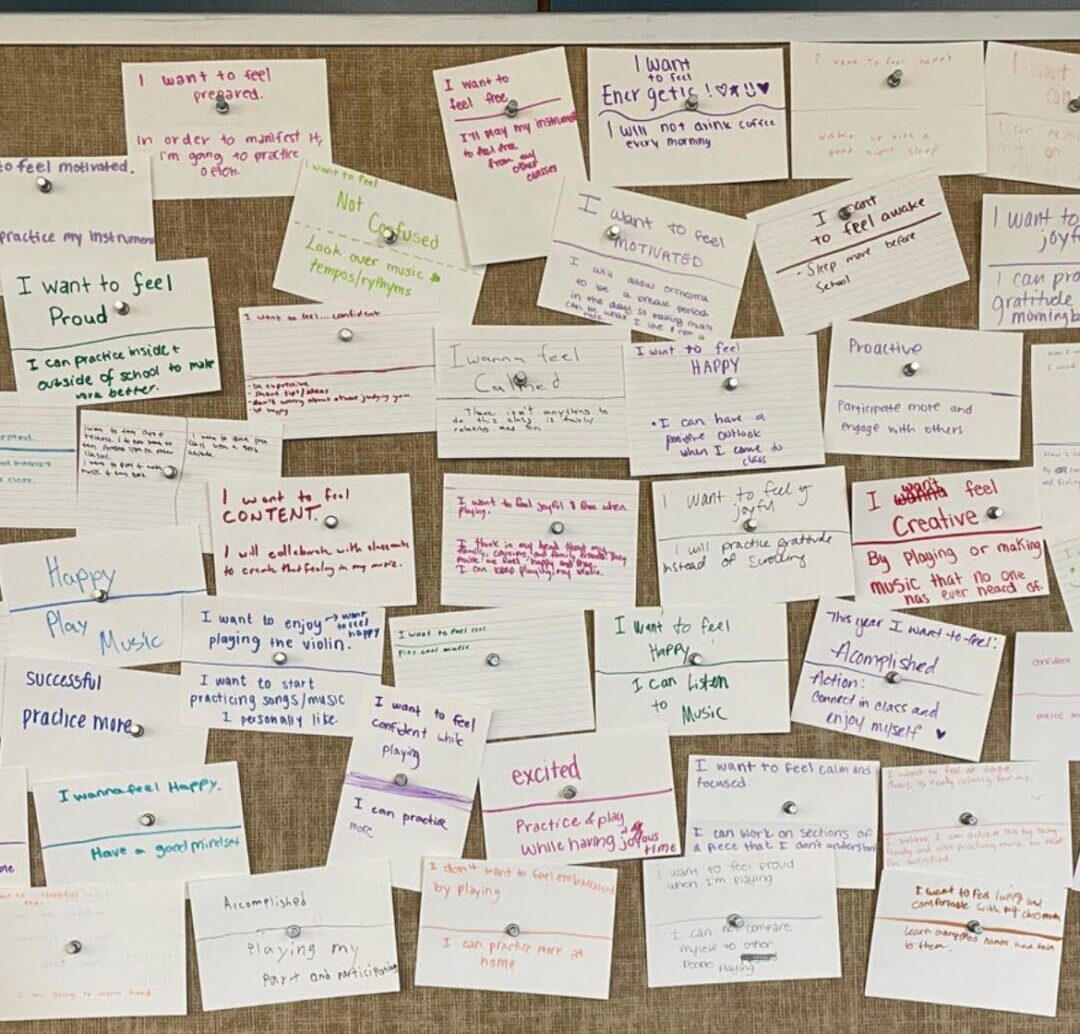
This simple activity at the beginning of the school year reaped endless rewards. We’d use them as reflection points–How have you done at manifesting the feeling you were hoping for? Have your thoughts changed? How?
It also helped me understand with greater clarity why students came to music in the first place. It wasn’t just so they could be better at their instrument. In fact, that was rarely the case. Most students recognized the social and emotional value that music could uniquely bring. Not only did reading their answers clarify their why to me, it helped me craft my classroom activities to better support our shared goals.
Empowerment in practice
Now that I no longer work with high schoolers but spend my days with college music education majors, I recognize that this message of empowerment and connecting it to your why needs to happen from day one. Just this past week, I had my sophomores complete a similar activity. I asked them to journal about how they wanted to feel this year as a music education student and what they could do to make that happen.
I recognize that we are all working in a field where so many of us are burned out, disillusioned, and under-supported. Again, there is much of this that can’t be changed. But by focusing on our why and connecting that to our what, where, when, and how, we can start to take baby steps toward the actions that best support the lives and careers we want to lead.
When reflecting on this with my sophomores, I talked about my own goals. This year I want to feel present. I don’t want to feel like my brain and body are occupying separate spaces. I don’t want to be pulled in multiple directions while I’m teaching but instead I want to be able to give my students my all. What can I do to make this happen? I made a commitment to keep my phone in my office while I teach (my number one distractor) and to not check emails during class time. I asked them to hold me accountable and support my efforts, just as I plan to support theirs
The Empowered Educator
Jen Rafferty didn’t stop with that workshop she gave in 2021. She built an entire business on empowering educators!!!
This past summer, I was giddy with joy when I received Jen’s new book, The Empowered Educator. It was everything Jen talked about in that session plus more. I earmarked and highlighted nearly every page and messaged Jen: “Every single teacher needs to read this book.” This is not a sponsored post, just a post where I get to be a cheerleader for people I’m proud of.
If you’ve been feeling burned out, or need a fresh perspective this school year, try asking your students:
How do you want to feel this year?
Then, in a quiet space, sit with the question for yourself. How do you want to feel? And what can you do to help make that happen?
I’d love to hear your answer. Feel free to share in the comments and know that I (and the rest of the F-flat team) am rooting for you.



I, like you, want to be present for my students. It’s a practice I started last year. And feel I didn’t always get it right but just considering how I could do that in the craziness of Berklee was empowering. But this year I want to expand it into all aspects of my life. If I’m watching a show, I want to just watch that show. If I’m having dinner w my husband, just be present. Talking to a friend? Really listen. Be present. Traveling? Be present – even to the sometimes frustrating parts. And then,NOTICE. Notice how I feel. Notice what my body is telling me. And then. LISTEN. Listen to the signals, listen to the heartbeats, listen to what I want. Then, ACT. If something isn’t feeling right, do something that I feel is right :)
SO…
Be present
Notice
Listen
Act
I think I need an acronym lol
I love this! Let’s reclaim the lost art of purposeful presence.